
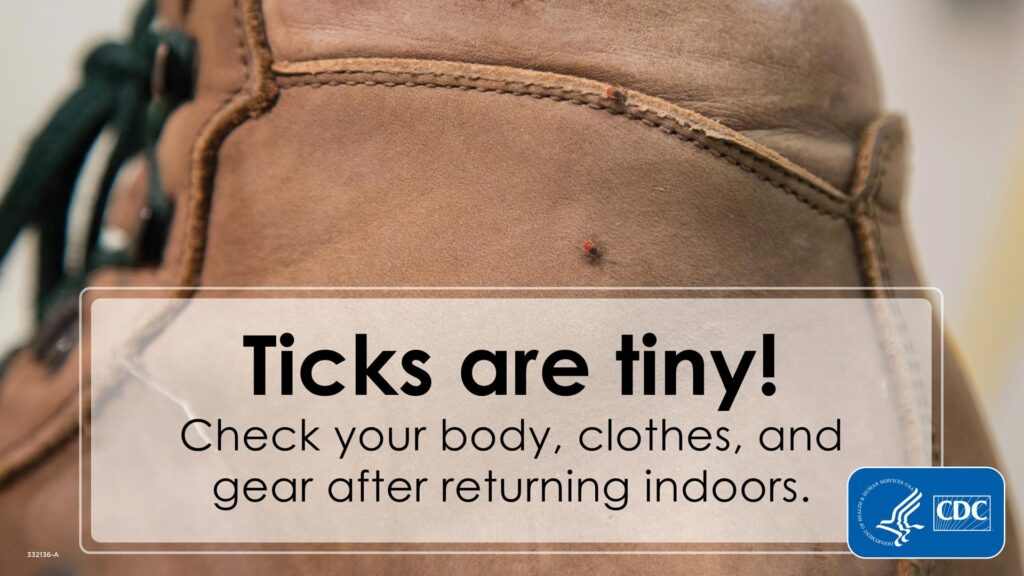
There are many diseases that can be transmitted by ticks so the best way to protect yourself is to reduce your exposure to ticks. Unfortunately, ticks are most active during warmer months when we spend more time outdoors. Here are some tips to prevent tick bites:
Before you go outdoors
- Know where to expect ticks. Ticks live in grassy, brushy, or wooded areas, or even on animals. Spending time outside walking your dog, camping, gardening, or hunting could bring you in close contact with ticks. Many people get ticks in their own yard or neighborhood.
- Treat clothing and gear with products containing 0.5% permethrin. Permethrin can be used to treat boots, clothing and camping gear and remain protective through several washings. Alternatively, you can buy permethrin-treated clothing and gear.
- Avoid contact with ticks. Avoid wooded and brushy areas with high grass and leaf litter. Walk in the center of trails.
- Use Environmental Protection Agency (EPA)-registered insect repellents containing DEET, picaridin, IR3535, Oil of Lemon Eucalyptus (OLE), para-menthane-diol (PMD), or 2-undecanone. EPA’s helpful search tool can help you find the product that best suits your needs. Always follow product instructions. Do not use products containing OLE or PMD on children under 3 years old. When used as directed, EPA-registered insect repellents are proven safe and effective, even for pregnant and breastfeeding women.
- If you are using sunscreen, apply sunscreen first and insect repellent second
After you come indoors
- Check your clothing for ticks. Ticks may be carried into the house on clothing. Any ticks that are found should be removed. Tumble dry clothes in a dryer on high heat for 10 minutes to kill ticks on dry clothing after you come indoors. If the clothes are damp, additional time may be needed. If the clothes require washing first, hot water is recommended. Cold and medium temperature water will not kill ticks.
- Examine gear and pets. Ticks can ride into the home on clothing and pets, then attach to a person later, so carefully examine pets, coats, and daypacks.
- Shower soon after being outdoors. Showering within two hours of coming indoors has been shown to reduce your risk of getting Lyme disease and may be effective in reducing the risk of other tickborne diseases. Showering may help wash off unattached ticks and it is a good opportunity to do a tick check.
- Check your body for ticks after being outdoors. Conduct a full body check upon return from potentially tick-infested areas, including your own backyard. Use a hand-held or full-length mirror to view all parts of your body. Check these parts of your body and your child’s body for ticks:
- Under the arms
- In and around the ears
- Inside belly button
- Back of the knees
- In and around the hair
- Between the legs
- Around the waist
If you find a tick attached to your skin, remove the tick as soon as possible.
Click here to view a tick removal fact sheet.
- Grasp the tick as close to the skin’s surface as possible using clean fine-tipped tweezers. If fine-tipped tweezers are not available, use regular tweezers or your fingers to grasp the tick. Grasp the tick close to the skin’s surface to avoid squeezing the tick’s body.
- Pull tick away from the skin with steady, even pressure. Don’t twist or jerk the tick. This can cause the tick mouthparts to break off and remain in the skin. If this happens, your body will naturally push the mouthparts out over time as your skin heals. You can also remove the mouthparts with tweezers. If you cannot remove the mouthparts easily with tweezers, leave them alone.
- Dispose of the live tick by taking one of these steps: place it in a sealed container; wrap it tightly in tape; flush it down the toilet; or put it in alcohol. Do not crush the tick with your fingers.
- After removing the tick, thoroughly clean the bite area and your hands with soap and water, rubbing alcohol, or hand sanitizer.
- If you find a tick attached to you, there may be other ticks on your body. Do a careful tick check to look for other ticks and promptly remove them.
Find more information, including an interactive tool called the Tick Bite Bot that will help you remove the attached tick and determine when to seek health care, if appropriate, after a tick bite at cdc.gov.